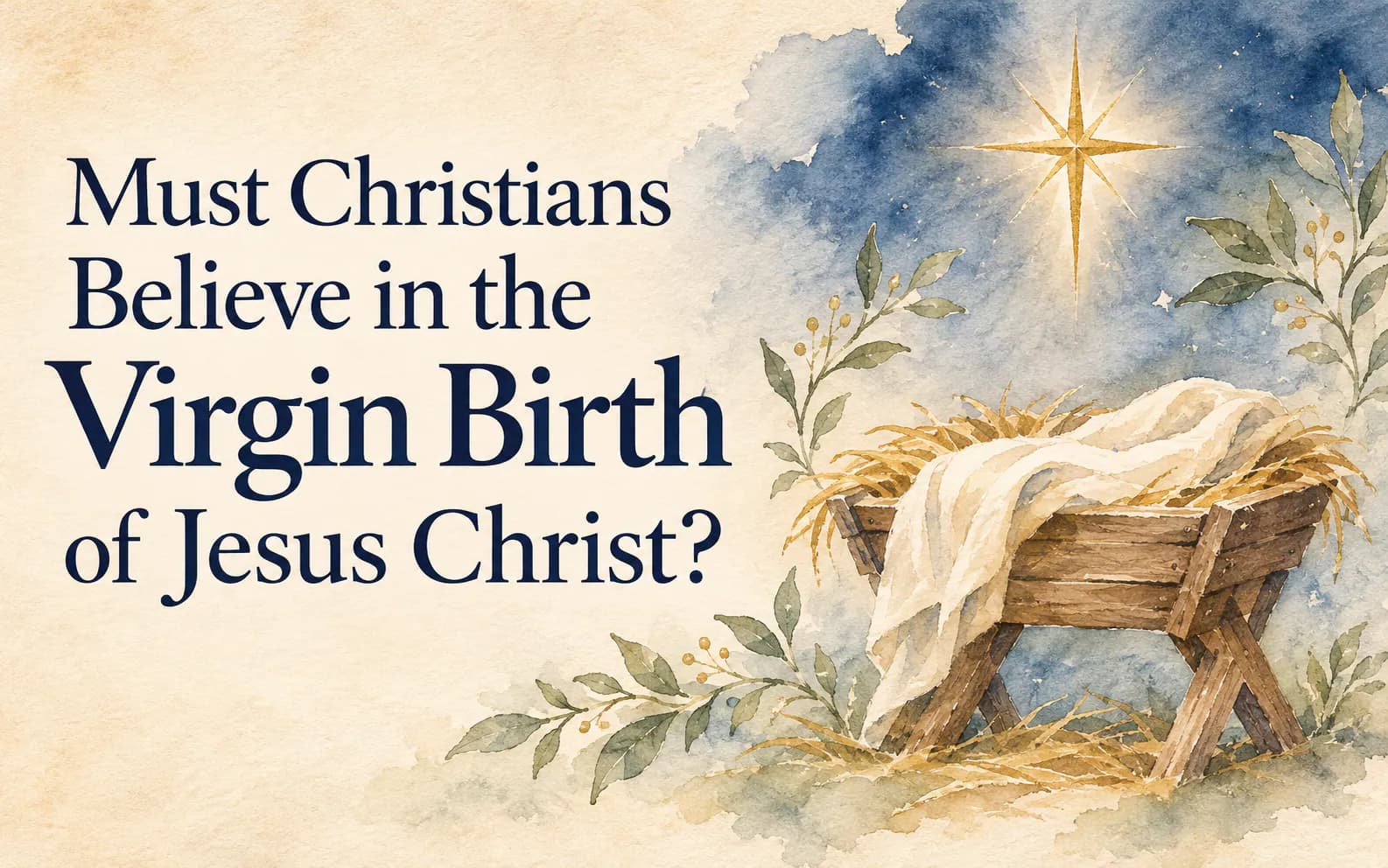
Must Christians Believe in the Virgin Birth of Jesus Christ?
Suppose someone says, "I believe that Jesus Christ died for my sins and rose again, but I do not believe He was born of a virgin."
How should we respond to such a statement?
Is the virgin birth an essential doctrine of the Christian faith? Or is it something Christians are free to accept or reject without any serious consequences?
According to Scripture, Christians should believe in the virgin birth of Jesus Christ because it is a truth clearly revealed in God's Word.
However, we must make an important distinction. There is a difference between not knowing about the virgin birth, not fully understanding how this miracle occurred, and knowingly rejecting what Scripture teaches about it.
To understand why this distinction matters, we must first examine what the Bible actually teaches.
1. What Does the Bible Teach About the Virgin Birth?
gives us a clear account of the birth of the Lord Jesus Christ.
Mary was engaged to Joseph. Before they came together as husband and wife, she was found to be pregnant through the Holy Spirit. When Joseph learned of her pregnancy, he initially intended to divorce her quietly.
However, an angel of the Lord appeared to him in a dream and explained that the child conceived in Mary was from the Holy Spirit.
records the same extraordinary truth.
When the angel Gabriel announced to Mary that she would give birth to a son, she questioned how this could happen since she was a virgin.
The angel explained that the Holy Spirit would come upon her and that the power of the Most High would overshadow her.
Matthew also identifies this event as the fulfillment of the prophecy concerning Immanuel in ().
One important observation is that neither Matthew nor Luke presents the virgin conception as a metaphor or merely a spiritual illustration. Both describe it as an actual historical event.
Therefore, the virgin birth is not a tradition invented by Christians in later centuries. It is a truth revealed in Scripture itself.
2. Why Is the Virgin Birth So Important?
To understand the significance of the virgin birth, we must first understand who Jesus Christ is.
teaches that the Word existed in the beginning, that the Word was with God, and that the Word was God.
Keep reading
Then, in , we read that the Word became flesh and dwelt among us.
What does this mean?
It means that the Lord Jesus Christ did not begin to exist when He was conceived in Mary's womb.
He is the eternal Son of God.
He was not an ordinary human being who later became divine. Rather, the eternal Son of God took upon Himself a true human nature and entered our world.
In Christian theology, this is called the Incarnation.
Jesus Christ is fully God and fully man. He did not surrender His divine nature when He became human. Rather, He took on a true human nature while remaining fully God (; ).
Matthew and Luke reveal how this incarnation took place. Through the miraculous work of the Holy Spirit, the eternal Son of God assumed human nature in the womb of the virgin Mary.
We must be careful not to suggest that Jesus became the Son of God because of the virgin birth.
He has eternally been the Son of God. The virgin conception was the miraculous means through which He took on human nature.
Therefore, the virgin birth is more than a remarkable event in the Christmas story. It is part of God's revelation concerning how His eternal Son entered the world to accomplish our salvation.
3. If We Are All Born with a Sinful Nature, How Was Jesus Christ Born Without Sin?
The Bible teaches that the entire human race has fallen into sin through Adam.
In , the apostle Paul explains that sin and death entered the world through Adam's disobedience.
also teaches that we are, by nature, children of wrath.
This means that we do not become sinners only after committing our first sinful act. As descendants of Adam, we are born with a sinful nature.
Our sinful actions reveal the sinful condition already present within us.
However, although Jesus Christ assumed a genuine human nature, He was completely without sin.
teaches that He was tempted as we are, yet without sin. also declares that He knew no sin.
How, then, was Jesus Christ born without sin?
Some might explain His sinlessness simply by saying that He had no human father.
However, Scripture does not teach that original sin is transmitted exclusively through the biological father. Mary herself was a descendant of Adam and belonged to fallen humanity.
tells us that the conception of Jesus Christ was a unique and miraculous work of the Holy Spirit. The angel declared that the child to be born would be holy.
Scripture does not reveal every detail of how this miracle occurred.
Nevertheless, it clearly teaches two truths: Jesus Christ assumed a genuine human nature, and He was entirely without sin.
Because He is the sinless Savior, He is uniquely qualified to serve as the mediator between God and sinful humanity (; ).
4. Why Must Christians Believe in the Virgin Birth?
This brings us to the central question of our discussion.
The primary reason Christians should believe in the virgin birth is that God has revealed it in His Word.
teaches that all Scripture is breathed out by God.
In , the Lord Jesus Christ declares that God's Word is truth.
Therefore, the final authority for Christian faith is not our personal experience, human reasoning, or individual opinions. It is the truth God has revealed in Scripture.
This does not mean Christians should never ask questions or carefully examine biblical teachings.
On the contrary, we should study Scripture diligently and seek to understand what God has revealed.
However, when Scripture clearly teaches something, we should not reject it simply because it appears impossible according to our ordinary human experience.
The virgin conception was not a natural human event. It was a supernatural act of God.
Our inability to explain fully how a miracle occurred does not give us sufficient reason to deny that it happened.
Therefore, believing in the virgin birth is not merely a matter of personal preference regarding a historical event.
It is also a matter of how we respond to the truth God has revealed in His Word.
If Scripture clearly teaches that Jesus Christ was conceived by the Holy Spirit and born of the virgin Mary, Christians have a responsibility to receive that testimony as true.
5. Is There a Difference Between Not Knowing About the Virgin Birth and Rejecting It?
Yes, and this distinction is extremely important.
Before considering it, we must remember how a person is saved.
teaches that salvation is by God's grace through faith. Our salvation does not depend on possessing a complete understanding of every Christian doctrine.
In , Paul summarizes the gospel by declaring that Christ died for our sins, was buried, and rose again on the third day according to the Scriptures.
With this in mind, we must distinguish three different situations.
First: Not Knowing About the Virgin Birth
A person may hear the gospel, recognize their sinfulness, and place genuine faith in the Lord Jesus Christ without having received detailed teaching about His virgin birth.
That person may not yet understand everything Scripture reveals concerning Christ's incarnation.
We have no biblical basis for declaring that such a person is unsaved simply because they have not yet learned this particular doctrine.
Salvation is not awarded to those who have mastered a certain amount of theological knowledge.
It is the gracious work of God through faith in Jesus Christ.
Second: Not Fully Understanding the Virgin Birth
A Christian might say:
"I believe the Bible when it says that Mary conceived Jesus through the Holy Spirit. However, I cannot fully explain how such a miracle was possible."
There is nothing inherently wrong with that response.
Such a person is not rejecting the biblical account. They are acknowledging the limits of their understanding while accepting God's testimony.
We can truly know what God has revealed without being able to explain every detail of how He accomplished His purposes.
Faith does not require us to understand the mechanics of every miracle.
It calls us to trust the God who has spoken.
Third: Knowingly Rejecting the Virgin Birth
Now consider a different situation.
Suppose someone understands what Matthew and Luke teach about the virgin conception but nevertheless insists:
"I understand that the Bible teaches the virgin birth, but I do not believe it happened."
This is a much more serious matter.
The issue is no longer merely a lack of information or difficulty understanding a miracle.
It also raises a question about that person's willingness to submit to the authority of God's Word.
Genuine saving faith rests upon the Lord Jesus Christ. That same faith also leads believers to receive the truths God has revealed concerning Him.
Therefore, knowingly and persistently rejecting a doctrine that Scripture clearly teaches is inconsistent with the proper response of Christian faith to God's revelation.
However, we must be careful about making final judgments concerning an individual's salvation.
Only God fully knows the human heart.
Our responsibility is not to pronounce an immediate verdict on every person who expresses doubt or disagreement. Instead, we should patiently listen, carefully explain the Scriptures, answer sincere questions, and encourage that person to receive God's truth.
At the same time, we should not minimize the seriousness of deliberately rejecting biblical teaching about Christ.
There is a significant difference between struggling to understand a doctrine and refusing to believe what God has revealed.
Conclusion: Must Christians Believe in the Virgin Birth?
Yes. Christians should believe that the Lord Jesus Christ was born of the virgin Mary because Scripture clearly reveals this truth.
However, the Bible does not teach that a person must possess a complete theological understanding of the virgin birth or explain precisely how the miracle occurred before they can be saved.
We must preserve the distinction between three things:
Not knowing what Scripture teaches about the virgin birth.
Believing what Scripture teaches while struggling to understand how the miracle occurred.
Knowing what Scripture teaches and deliberately rejecting its testimony.
These are not the same.
The virgin birth reminds us of the extraordinary truth of the incarnation. The eternal Son of God took upon Himself a true human nature through the miraculous work of the Holy Spirit.
He lived a sinless life, offered Himself as a sacrifice for our sins, conquered death, and rose again.
Our salvation does not rest upon our ability to explain the virgin birth or our level of theological knowledge.
Our salvation rests entirely upon the Lord Jesus Christ.
Yet because He is our Savior and Lord, we are called to receive the truths God has revealed concerning Him.
Christian faith is not about selecting only those biblical teachings that seem reasonable or personally acceptable to us.
Christian faith means trusting the God who speaks truth and receiving what He has revealed in His Word.
Scripture References
; ; ; ; ; ; ; ; ; ; ; ; ; ; .
Life & Scripture — Connecting Biblical Truth to Everyday Life